
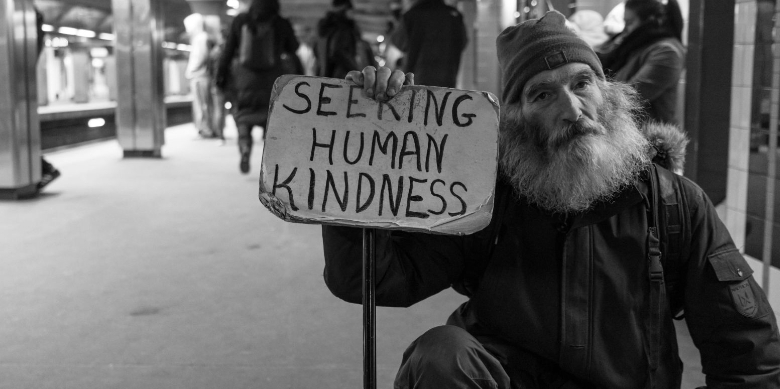
Recently, I was reflecting on a concept from Martin Buber that has become increasingly important to me throughout my life.
There are two ways we can meet another person.
We can meet them as an “it.”
Or we can meet them as a “thou.”
At first, this distinction sounds philosophical.
But the greater life experience I have, the more practical it becomes.
Because treating another person as an “it” is surprisingly easy. In fact, it is often quite automatic.
When we are stressed, afraid, exhausted, overwhelmed, or trying to protect ourselves, we can stop seeing the whole person standing before us.
Instead, we begin to see a role. A problem. An obstacle. A diagnosis. A position. An opinion. A behavior. An object of concern.
Without realizing it, we stop relating to the person and begin relating to our idea of the person.
Martin Buber called this the I-It relationship.
I have certainly done it.
Years ago, after my beloved Yumi underwent a complicated heart procedure, the doctors told him to rest and avoid travel. When we returned home, he announced that not only did he intend to travel, but that he wanted to go to South Africa.
I was horrified and certain that I was right, that I was protecting him, and that he was making a terrible decision.
Only later, after we crossed the bridge and truly landed in each other’s worlds, did I realize something startling.
I had stopped seeing my husband.
I was seeing a heart. A condition. A risk. An object of concern.
Then Yumi said something that changed my life.
“I’m not a heart. I’m a man with a heart.”
Those words landed deeply because they were true.
I had unconsciously turned the man I loved into the problem I was trying to solve.
And in doing so, I had lost sight of his humanity.
The I-Thou relationship asks something different of us.
It asks us to meet another person in their fullness.
Not as a role, or a problem, or a category, but as a living, breathing human being with their own experience, dignity, fears, dreams, wisdom, and destiny.
This does not mean we always agree.
It does not mean we stop having concerns.
It does not mean we abandon discernment.
It means we remember the person again and again, even when it would be easier not to.
Recently, during a conversation about aging parents, someone used a phrase that stayed with me.
She realized that her mother had become “an object of concern.”
I think many of us know that experience.
We worry. We plan. We monitor. We try to protect. And somewhere along the way, we risk seeing the concern more clearly than the person.
The challenge is not to stop caring but to keep honoring the humanity of the one we care about.
To remember that they are not their diagnosis, their limitations, their struggles, or their mistakes.
They are a person. Just as we are.
Martin Buber once suggested that every moment presents us with a choice.
Will we meet the other as an object, or will we meet them as a fellow human being?
I have come to believe that this choice is rarely automatic.
It is a deep human decision and one we must make again and again.
Every time we do, something sacred becomes possible in the space between.
—
👉 Are you a helping professional interested in learning Encounter-centered Transformation®? Explore Hedy’s self-paced professional study experience, Encounter-centered Transformation®: Essentials.